Murray State’s sports medicine director Eric Frederick on navigating college athletics during COVID
MURRAY, Ky. (BVM) — The global pandemic has revealed a myriad of essential workers across all industries, and for athletic departments at colleges and universities across the country, that essentialness was bestowed upon athletic trainers.
Eric Frederick is the assistant athletic director for sports medicine at Murray State University in Murray, Ky. Frederick has been involved within sports medicine and athletic training for 27 years and currently works directly with the university’s basketball and golf programs heading into his 28th year. His responsibilities as an sports trainer also stretch into the administrative side of athletics.
Though Frederick’s schedule gives him plenty of things to be accountable for, when COVID-19 hit, the additional responsibility of becoming the health director and wise counsel regarding the virus became a role he had to fill.
“All of a sudden, we were the ones that were supposed to know everything about the pandemic,” Frederick said. “It was new to us when it all started back in January of 2020 and it showed up in the news and in medical journals. We became aware that the virus could send everyone at the university home before the semester was over, so I started reading some more and became very educated on the matter.”
There was a distinct brevity in the time the news of COVID showed up and the school subsequently shut down. Soon after the concern emerged about the virus, the University, like many across the country, was empty. With the pause on life and athletics, Frederick used the time to study more about COVID and its impact.
“I ended up taking a five week online course with Johns Hopkins University on the virus and contact tracing,” Frederick said. “That’s where I learned the progression of the disease and how it works so that I would be able to recognize it when people came in and how to test for it. There was also how to do the quarantines and isolation; it was very much a ‘building the plane while in midair’ type situation because it was right on top of us and we had to figure out how to handle it.”

With the lack of information in general early on, it was very much up to the individual institutions to navigate the virus and develop plans to bring students and athletes back to their respective campuses. Athletic departments were looking to the NCAA for guidance on the issues, and though the national organization originally suggested that each college handle the issue themselves, pushback caused the NCAA to release some guidance to schools across the country.
“This 48 page document came up from the NCAA that basically dictated what it is we can do for our student athletes and events on NCAA campuses,” Frederick said. “So I had to digest that very quickly and put a plan into action for the university based on that. Of course, all of that comes with a financial side to it as well and fortunately the government and the COVID funding and all that helped cover some expenses.”


When it came time to return to campus for student athletes in the Fall of 2020, those guidelines and safety precautions changed the daily life of everyone within athletics. With a total of over 375 student athletes at Murray State University, the athletic department was conducting over 400 COVID tests a week.
“Doing the amount of testing we had to do for our athletes requires a lot of time,” Frederick said. “We have a great relationship with a diagnostics lab in Covington, Ky. who the university signed a contract with to provide us the testing supplies. As soon as we send off those samples, we get the results back the next day or two days later. I can see the results right at my desk and move student athletes who tested positive wherever we need to for contact tracing.”
Even with all of the precautions that were taking place on campus and in athletics, playing sports was deemed to be not worth the risk for the Ohio Valley Conference. Just as the season was about to kick off, all fall sports for Murray State were postponed to the spring.
“I hated the fact that we canceled all athletic events for the fall semester,” Frederick said. “A fall season could have happened with as much testing as the teams were doing. There would have been more cancellations and student athletes that missed time in the fall because of the amount of positives we had, but I think it still would have been safe to compete.”
Postponing the fall season to the spring gave Frederick and his staff some relief simply because it gave them time to catch up. The demand that COVID had on the athletic department took so much time away from administrators and coaches that Frederick believes the student athlete experience was partially sacrificed.


“The care that we normally provide for our student athletes really wasn’t up to par because we didn’t have time to do both,” Frederick said. “That postponement was sort of a blessing in disguise. We realized that our job is to take care of our student athletes. Without these events and without student athletes, we don’t have jobs. Then, moving to the spring, when we had every sport at Murray State going on at the same time, that turned out to be doubly hard.”
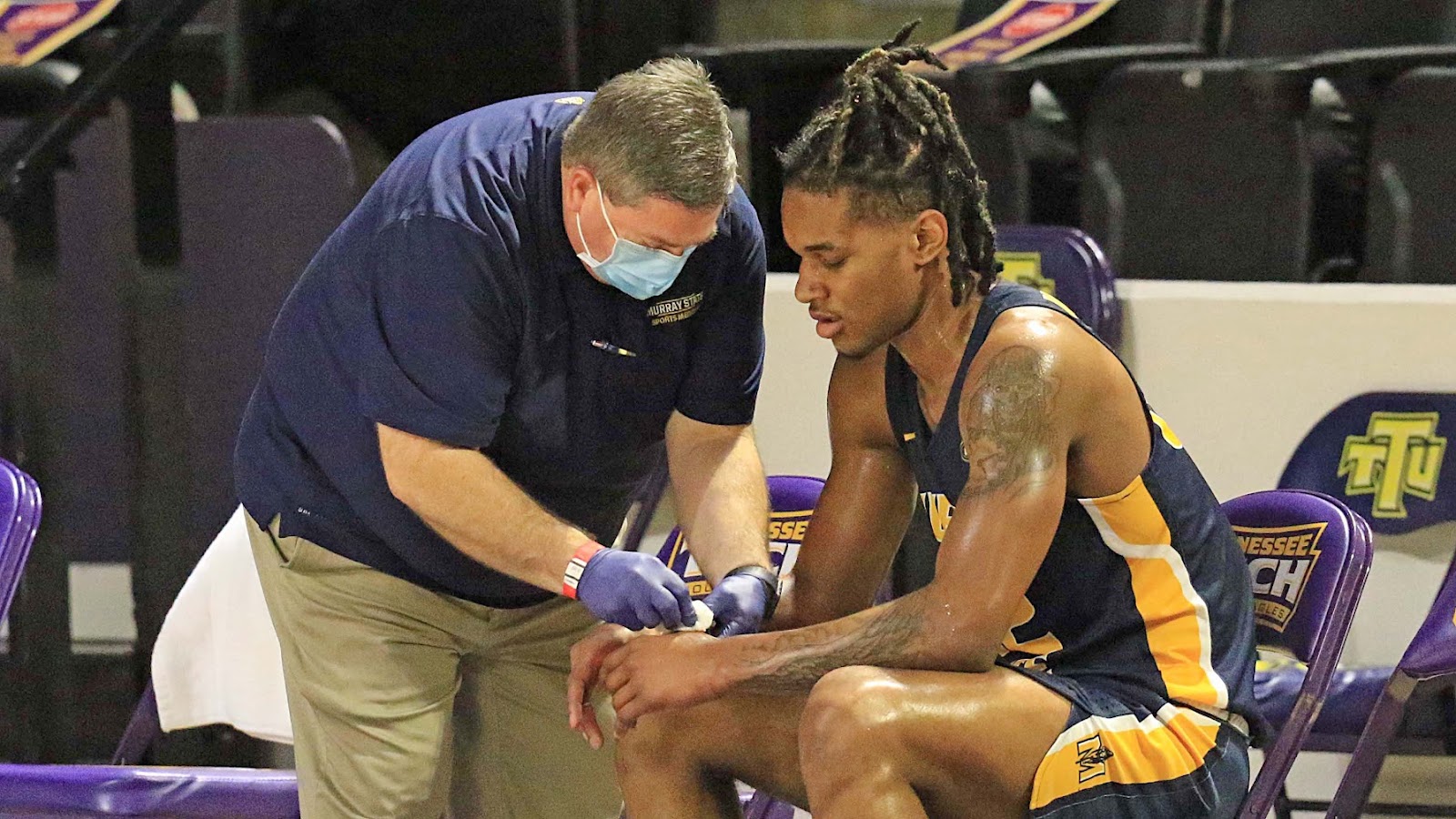
Once the chaotic “all-at-once” athletic season kicked off for Murray State University in the spring of 2021, a feeling of normalcy returned to the lives of student athletes and those who work in athletics. Though sports returned under the lights, behind the scenes, the impact of the virus and the sacrifices it took to compete were apparent.
“The interesting thing about it was, because of the nature of the virus, we intentionally kept teammates away from each other,” Frederick said. “Things looked different, and teams weren’t able to do what they normally do from a team building and practice standpoint. In order to protect our athletes and to be able to stay on the field and not be in a situation where they lost games or in some instances would miss weeks of games if they contact traced or tested positive, they had to isolate and do things differently. It wasn’t a normal college experience.”
As the season progressed, the teams continued to compete with minor slip ups and outbreaks. All in all, Frederick was very pleased with how the student athletes bought into the precautions and recommendations in order to keep their teams in a position where they could compete each week. When the final games of the semester were played and the hectic spring schedule for Murray State Athletics was winding down, the vaccine became readily available to college aged students, something that Frederick thinks is critical in returning to the normal athletic experience.
“This next season, the NCAA put the decision making and monitoring back on institutions and how things are in each community,” Frederick said. “The way the NCAA has things panned out, if you’re vaccinated, life is much easier for you. You’re not required to test, you don’t have to quarantine if you come in contact with somebody that’s positive, it doesn’t take you out of the game, so to speak. We’re really encouraging our student athletes to get the vaccine because it provides an easier road to keep our student athletes striving for the championships they want to win. Vaccination is the best way to do it.”
Unlike last season, many conferences have announced that contests that are missed by athletics programs due to COVID outbreaks will not be rescheduled, but rather forfeited. Though the fairness of this development is up in the air, Frederick realizes that becoming vaccinated can actually give teams a competitive edge.
“The announcement spurred some action,” Frederick said. “I think it’s fair. Do I think it’s right? Maybe, maybe not. However, we told our teams what the situation is going to be, this is what could happen, and that’s all we did. Deciding not to get vaccinated could theoretically cost you a championship, and after that became clear, our student athletes made their decisions from there.”
Now heading into the 2021-22 season for athletics in what can be described as the most challenging span of Frederick’s 27-year career, he still loves his job and looks forward to whatever obstacles will be thrown his way.
“No two days of my career have been the same, and that is one of the reasons why I got into this profession because there’s always something happening,” Frederick said. “The process that surrounded the pandemic in athletics has been a really good challenge and a real test of fortitude. One of my favorite things about my job is seeing an athlete compete again after a long battle and recovery with injury. Likewise, seeing all those teams compete again for the first time last spring was fun and fulfilling. I’m excited to see a return to our normal schedule this year, and though the battle isn’t over yet, all the hassle and work is all worth it to see our student athletes return to competition.”